
A retrospective on my AI Instagram film

I made a short film using AI and put it on Instagram. It did well as far as my standards go... It got 200,000+ views, 8,000 likes, and 195 comments. (you can watch it here, it's about Simulation Theory).
The likes felt nice but the comments... ugh. They distilled to one call‑and‑response that kept popping up in different forms:

This polarized refrain held true as the comment threads unraveled, and it became clear this wasn’t just about my film. What follows is a retrospective - what I saw, what I learned, and the questions I’m bringing into the future.
Pretty soon after posting, I got hit with a #AIslop, which got 143 likes and 23 replies.

Various definitions and features of AI slop emerged as commenters, some angry, some self-appointed protectors of Art, piled on.
“Low‑quality, emotionless, feed-flooding, minimal human effort, no talent, theft from actual artists, not art”
@bien.desparchado, jumped in and tried to reframe the pile‑on by distinguishing art from craft:
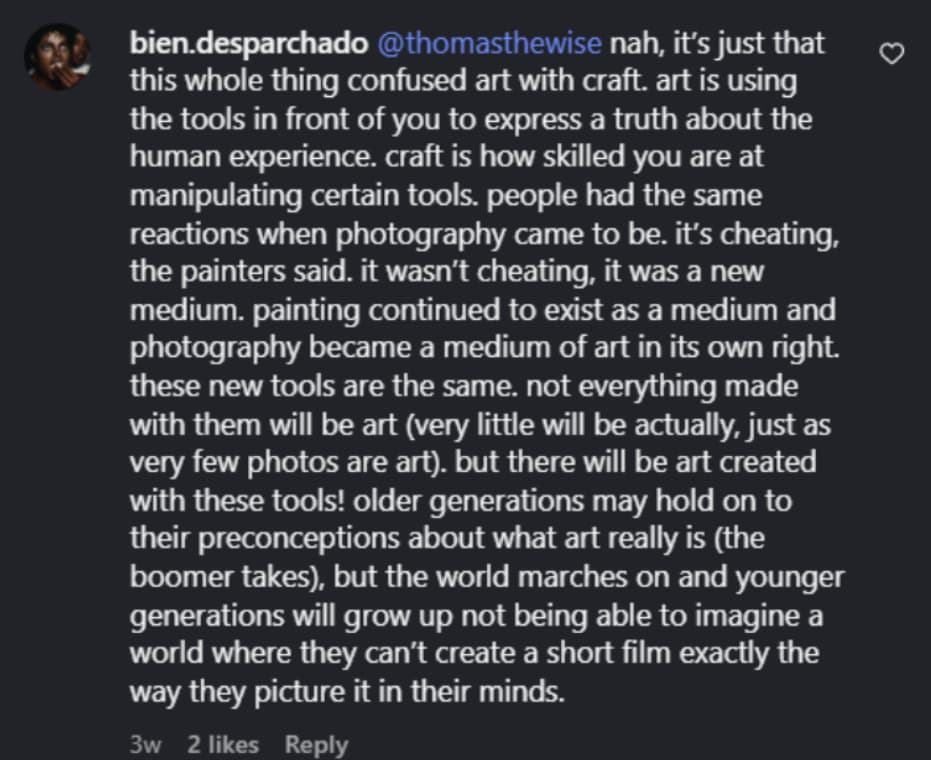
It was a cogent nuanced argument (more you can say for most comments), and it made me think...
We’re used to equating art with craft and craft with visible labor - hours on a set with a crew, swapping lenses, moving C stands, body aching by the martini shot. With AI, the labor shifts: more time in intent, curation, iteration, editing, and taste. More time in the invisible and its mostly solitary.
It’s not less work per se, it's work that’s harder to see and that requires a process that is unfamiliar to people. For the AI critics, if you can’t see the process, the craft, it isn’t there. If you can see its flaws, there’s nothing else, its slop.
My own view: craft is how you link a chain of decisions that add up to meaning. Tools change, the decision‑making doesn’t have to. (You can read my take on how decisions are the measure of creativity here).
Personally, I enjoy learning how to use tools, ones as simple and unfiltered as brushes and pens, (Fine Art my original background), to VFX sup-ing full CGI pipelines, now AI workflows. Though for many, the dislike of AI as tool may reveal an underlying anxiety of threat to their livlihood... more on that later.
A comment that taught me about audience expectations and AI:
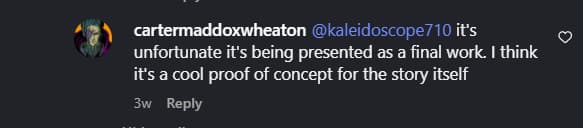
Many viewers seem more comfortable with AI as pre‑visualization or story prototyping tool than as the final thing they’re asked to emotionally invest in. Filmmaking already respects prototypes - animatics, test shoots, look‑books. If I had positioned the post as a “concept video” would some defenses have dropped? Probably.
The lesson for me: label the intention. A piece can be a sketch or a finished short; but ambiguity invites people to fill in the blank with whatever fight they’re already having.
Another viewer surprised me with a concession:
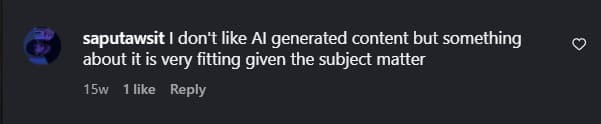
Like any medium, AI can be misapplied or it can be poetic when serving the theme. If your story is about memory slippage, identity drift, synthetic selves, or corporate mythmaking, the “AI look” can be a feature, not a bug. The decision to serve the subject matter is the point, the tool is a means.
If viewers sense why a tool was chosen, they grant more leeway. If they sense it’s there because it was easy, the verdict is swift: SLOP.
Then there’s the moral outrage - some of it crude and kind of funny, some of it earnest:
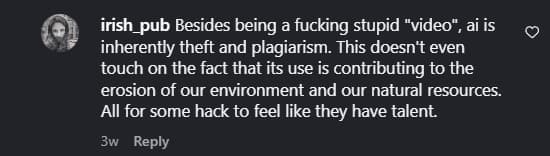
This was the most common one-two punch: training‑data ethics and energy use. (they also called me a no-talent hack. bless you @irish_pub.)
These are legitimate concerns. The legal landscape on training data is still unsettled; models are built on oceans of human work, often without consent or compensation. And compute burns energy (though so does every part of our digital lives, including endlessly streaming and doom‑scrolling.)
As individual creators, one can’t litigate these big questions alone, but we can hold two truths at once: AI tools are very useful to us professionals AND they currently have moral bugs.
We are simultaneously told that we are destroying the environment / taking jobs from real artists AND that we have to get on the AI train or we'll be left behind ("AI won't take your job, but someone using AI will").
I'd like to think I am one of the real artists this commenter is trying to protect, and there are many lifelong professional creatives who are stuck in this hard place.
Amidst the ethics‑and‑energy critique, another argument surfaced: AI grants access.
Traditional filmmaking is a permission economy - capital‑intensive, risk‑averse, and optimized to recycle IP, which means a lot of storytelling gets filtered out by cost and gatekeeping.
One commenter sums it up, followed by combative retorts:

This is the democratization argument: more experiments, more voices, more weirdness is better. Let a thousand misshapen AI flowers bloom. Most of them won’t land (a few might), but for creators outside Hollywood’s gates, an inexpensive AI film can be the difference between no film and something you can show the world.
And as one commenter alludes to, we already scroll through oceans of “human slop”: from shameless meme creators shooting for virality to genuine (and genuinely shitty) attempts at filmmaking. There's a double standard here: digital consumers like @irish_pub are OK with "human slop" but not "human slop made with AI".
That said, AI-enabled access and democratization does not mean fairness. Platforms still control distribution, and “free” tools will continue to monetize users.
But the access argument still stands on its own: fewer gatekeepers means more shots on goal. Whether that’s worth the trade‑offs is the real debate - not whether the person who took the shot used the “right” camera.
In spite of the potential lowering of the Hollywood drawbridge, the anxiety around job loss is real. Yes, some tasks will be automated and plenty of talented professionals are staring down displacement because technology replaces certain kinds of labor, and reprices the value of one's craft.
And yes, we’ve been here before: photography didn’t end painting, digital didn’t end film: they changed the job market around them. BUT...
The difference now is the speed. AI is reshaping the creative job market faster than any previous shift, and many craftspeople simply won’t have the time or resources to adapt at this pace. That makes this moment genuinely frightening, and deeply sad for creators caught in the transition.

A handful of comments were utterly pragmatic and, in a way, the truest judge, which seemed to simply ask: did it move me?
For them the proof is in the pudding, and the process is trivial. I don’t dismiss this stance. Most of the time, audiences don’t read the footnotes or watch the credits, they simply consume or don’t. Which leads to a thought experiment I’ve been toying with:
Say you are ethically opposed to AI music. You hear a song, you start tapping along and decide you really like it. Then later you learned it was AI‑generated. Did you actually love it less in the moment? If the beat made you move and you don’t know (or can’t know) its origin, does your body tell the truth?
The current climate is such that labels (#AIslop) are used as fear-mongering brands, while studios implement token AI standards and practices to mitigate PR risk and evade audience outrage - all the while feeling the pressure to use AI to save time and cut costs (just like individual creators). It all feels very Orwellian at the moment.
I think we will inevtiablly head toward an era where the “AI” label fades in relevance. Not because ethics don’t matter, but because verifying that something is AI will get harder, audiences will normalize to it, and they will default to a “does this move me? / “I’d watch this” mentality.
That isn’t a moral argument; it’s a prediction about audience appetite and human psychology in the age of AI content.
After wading through a few hundred comments, one thing became clear:
Our cultural conversation about AI is in its first draft - early, confused, angry, and loud. As discourse sorts itself out, people reach for simple narratives: innovation good, plagiarism bad, job theft, environmental doom etc.
Artists defend craft, technologists defend tools, workers defend jobs, audiences defend their time. My film landed as threat, promise, offense, or entertainment depending on the audience identity type with most using “AI slop” as a cudgel, and “democratization!” a shield. Neither resolves anything, but both give people something to hold on to while the ground shifts underneath us.
Over time, more AI work will be made, reference points will accumulate, positions will mature and legal and economic frameworks will solidify. Our vocabulary will sharpen and deepen. Until then the comment chorus will likely refrain:
“This was incredible.”
“No. It’s AI slop.”
